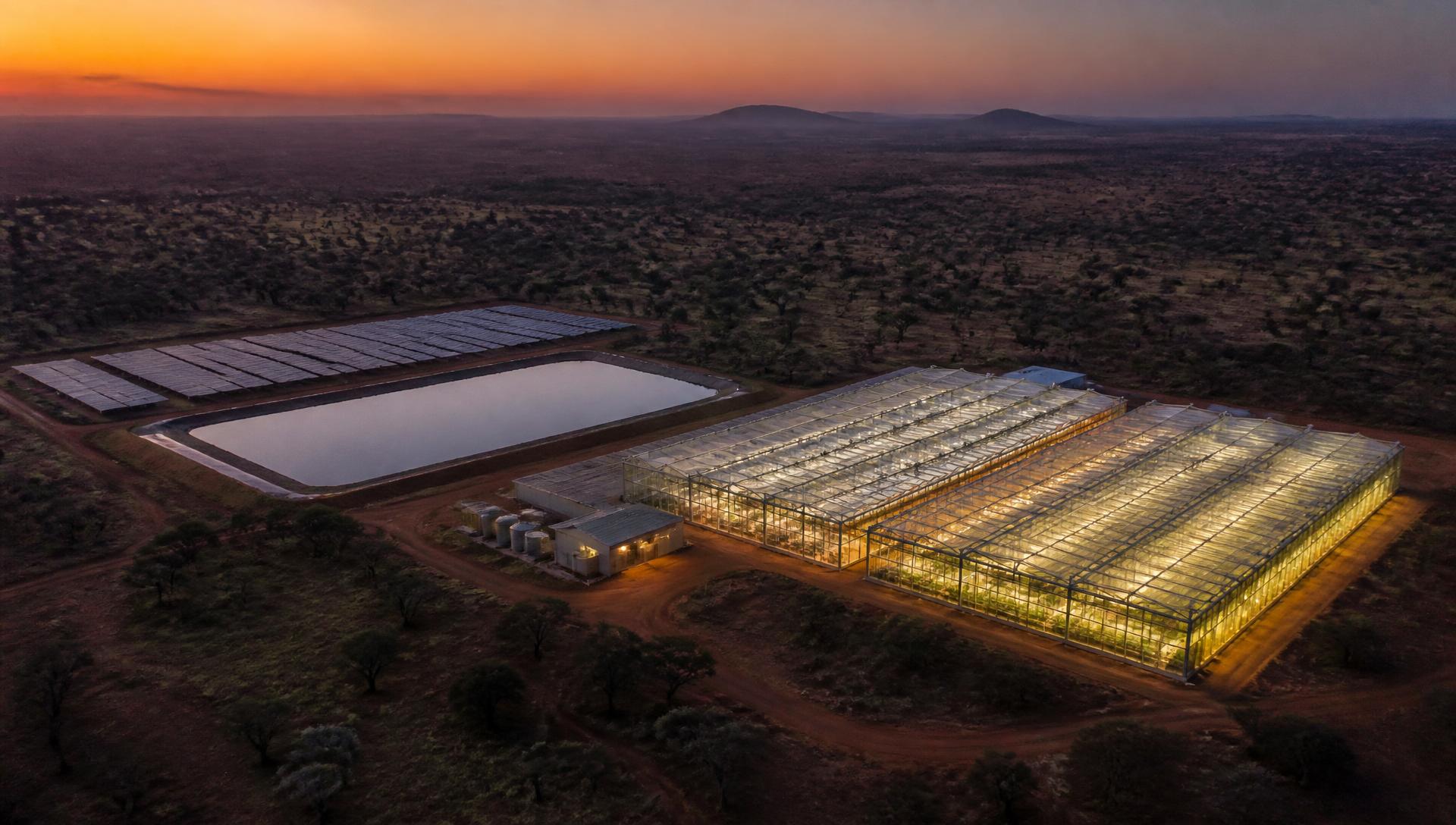
More production. Fewer resources. Better resilience.
Sustainability in horticulture is an engineering outcome. It is decided in the water balance, the climate strategy, the energy design and the choice of systems — long before a facility is operating.
Efficiency engineered in from the beginning.
Each of these outcomes is a design decision with a cost and a consequence. We make them explicit during design rather than retrofitting them later.
Water efficiency
Protected cultivation with precise irrigation uses a fraction of the water of open-field production, and recirculation recovers more of it where water quality allows.
Energy efficiency
Demand is reduced through design before supply is sized, and renewable integration is assessed against real operating profiles.
Higher productivity per hectare
Controlled environments produce more from less land, reducing the pressure to expand cultivated area.
Reduced chemical dependency
Physical exclusion, hygiene protocols and stable climate conditions reduce pest pressure and the interventions needed to manage it.
Resource recovery
Drain water, rainwater harvesting and nutrient recovery are evaluated as part of the water balance, not treated as add-ons.
Climate resilience & local food security
Production that is buffered from heat, drought and erratic rainfall supports consistent local supply and reduces dependence on imports.
Build a facility that performs on resources as well as yield.
We can assess water availability, energy demand and efficiency measures for your site as part of an early project assessment.